Drainfield & Leach Field Installation
The tank handles separation. The drainfield does the actual work of returning treated wastewater safely to the soil — and it's the part most likely to fail first.
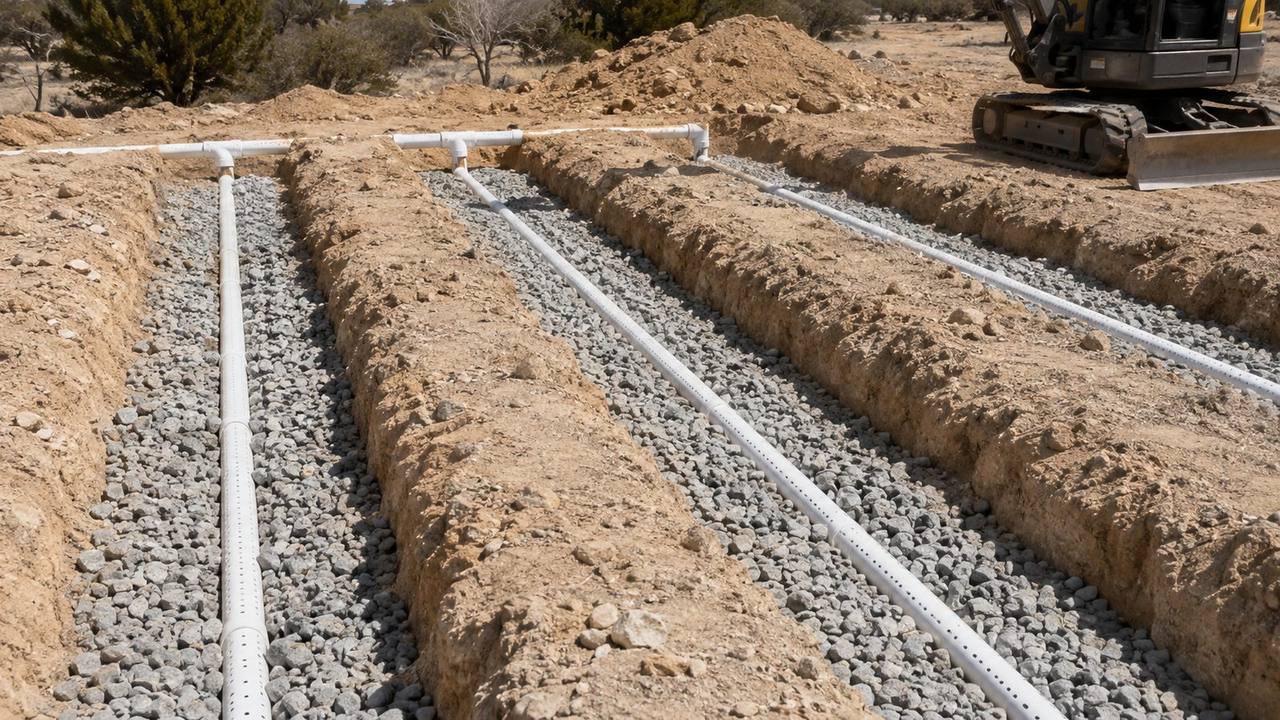
A septic tank's job is simple: let solids settle out and let liquid move on. The drainfield (also called a leach field) is where the real treatment happens — effluent is distributed through perforated pipe into gravel-lined trenches, where it filters slowly through the soil, which does the final biological treatment before the water reaches groundwater. When a drainfield fails, no amount of tank pumping fixes it.
How your drainfield gets designed
Drainfield size and layout are driven directly by your percolation test results. Faster-draining soil generally allows a smaller footprint; slow-draining or caliche-heavy soil requires a larger field, deeper gravel bed, or a different trench configuration to handle the same volume of wastewater safely. This is why two homes of the same size, a few miles apart, can end up with very different drainfield designs — the soil, not the house, drives the layout.
- Trench or bed layout, sized from your percolation test results
- Gravel bedding and perforated distribution pipe, laid to a consistent grade
- A distribution box or drop boxes to route flow evenly across the field
- Proper setbacks from wells, property lines, and structures
- Backfill and site restoration once the system passes inspection
When a conventional drainfield won't work
Some lots simply can't support a standard gravel trench drainfield — shallow caliche, high groundwater, or a small lot without enough room for setbacks are all common reasons in this area. In those cases, the design shifts to a chamber system, drip distribution, or other alternative that either treats the effluent more thoroughly before it reaches the soil or spreads it more efficiently across a smaller footprint.
Want to understand what's actually under your lot before you get a design? Start with the percolation test & soil guide.
Get your drainfield evaluated
Whether you're installing new or replacing a failed field, tell us about your property and we'll connect you with a licensed installer.
- Sized to your actual perc test results
- Handles both new installs and drainfield-only replacements
- Familiar with caliche and tight-lot workarounds
Request received
Thanks — we've got your details and will be in touch shortly to connect you with a local septic professional.
Related pages
Frequently Asked Questions
A well-designed drainfield matched to accurate soil data can last decades. Most failures come from an undersized original design, tree roots, driving or building over the field, or simple age combined with heavy use.
Grass is fine and even helps. Avoid trees and deep-rooted landscaping (roots seek out drainfield pipe), and never build a structure, driveway, or patio over the field — the soil needs to stay uncompacted to keep absorbing water.
Generally yes, if your tank is still structurally sound and correctly sized. See the cost guide for typical ranges.
Get your drainfield assessed
Tell us what's going on and we'll connect you with a licensed local installer.
Get a Free Quote