Septic Tank Installation for New Construction
Building on a lot without municipal sewer access? A new septic system starts with a real site evaluation and percolation test — not a tank size picked off a shelf.
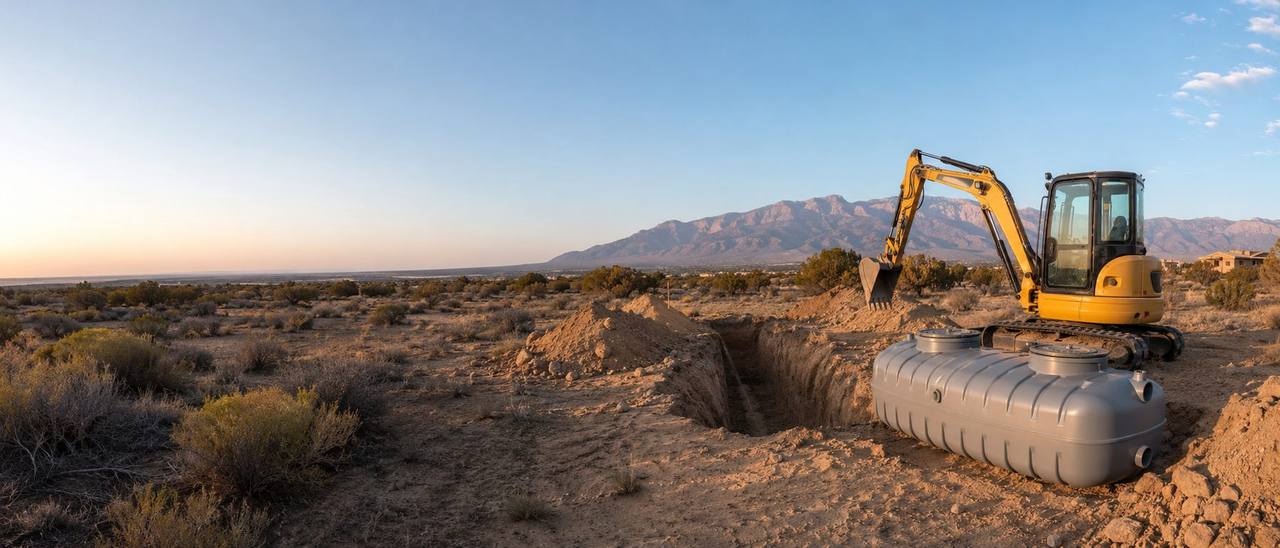
If you're building a new home, subdividing land, or putting a manufactured home on a lot without access to municipal sewer, you need a permitted on-site liquid waste system before construction can move forward. That's true whether you're inside Albuquerque city limits, out in Rio Rancho, or on acreage in the East Mountains — no New Mexico jurisdiction will let you build without one.
Why installation starts with the soil, not the tank
Every conventional septic system relies on the soil underneath your drainfield to finish treating wastewater. That means the first real step isn't picking a tank — it's a site evaluation and percolation (perc) test that tells your installer how fast water moves through your specific soil. In the Albuquerque metro, that answer varies enormously: sandy soil in parts of the Rio Grande valley drains very differently than the caliche layers common on the mesas and East Mountain foothills. Skip this step, or estimate it, and you risk a system that's undersized, over budget, or rejected at permitting.
- Site evaluation — access, setbacks from wells and property lines, structures, slope
- Percolation test or soil profile — how fast your soil actually absorbs water
- System design — tank size and drainfield layout sized to your bedroom count and perc rate
- Permit application filed with the correct authority for your property's jurisdiction
- Excavation, tank placement, and drainfield construction by a licensed installer
- Backfill, site restoration, and the final inspection that closes out your permit
How your system gets sized
Tank and drainfield sizing in New Mexico is based on your home's number of bedrooms and the percolation rate measured on your specific lot — not a flat statewide number. A 3-bedroom home on fast-draining sandy soil and a 3-bedroom home on slow caliche can end up with meaningfully different drainfield designs, even though the tank size is similar. This is decided during the design phase of your permit application, after your site evaluation. Anyone quoting a firm tank size before seeing your soil test is guessing.
Conventional systems vs. alternative systems
Most lots with decent drainage qualify for a conventional gravity-fed tank-and-drainfield system, which is the simplest and least expensive option. If your soil percs too slowly, your lot is too small for a standard drainfield, or your groundwater sits too close to the surface, your design will need to shift to an aerobic treatment unit or another alternative system instead — common on tighter East Mountain and Placitas lots with shallow caliche.
Related reading: see the full New Mexico septic permit process and the percolation test & soil guide for a deeper look at what drives your design.
Start with a site evaluation
Tell us about your lot and we'll connect you with a licensed installer who can evaluate your property and walk you through permitting.
- Serves new construction across the entire metro
- No obligation to move forward after your evaluation
- Works with both NMED and county-permitted jurisdictions
Request received
Thanks — we've got your details and will be in touch shortly to connect you with a local septic professional.
Frequently Asked Questions
New Mexico allows a qualified homeowner to install a conventional system on their own primary residence after passing a state qualification exam — but you still need to obtain the permit and pass the same inspections a licensed contractor would. Most homeowners find it faster and less risky to hire a licensed installer (license classification MM-1, MM-98, MS-1, or MS-3).
Timelines vary with permit processing and weather, but plan for several weeks between your initial site evaluation and final inspection sign-off, including time for the perc test, design, and permit review before excavation even starts.
Yes. Any new or modified on-site liquid waste system requires a permit before construction, regardless of whether the structure is site-built or manufactured.
Ready to get your lot evaluated?
Tell us about your property and we'll connect you with a licensed installer serving your area.
Get a Free Quote